
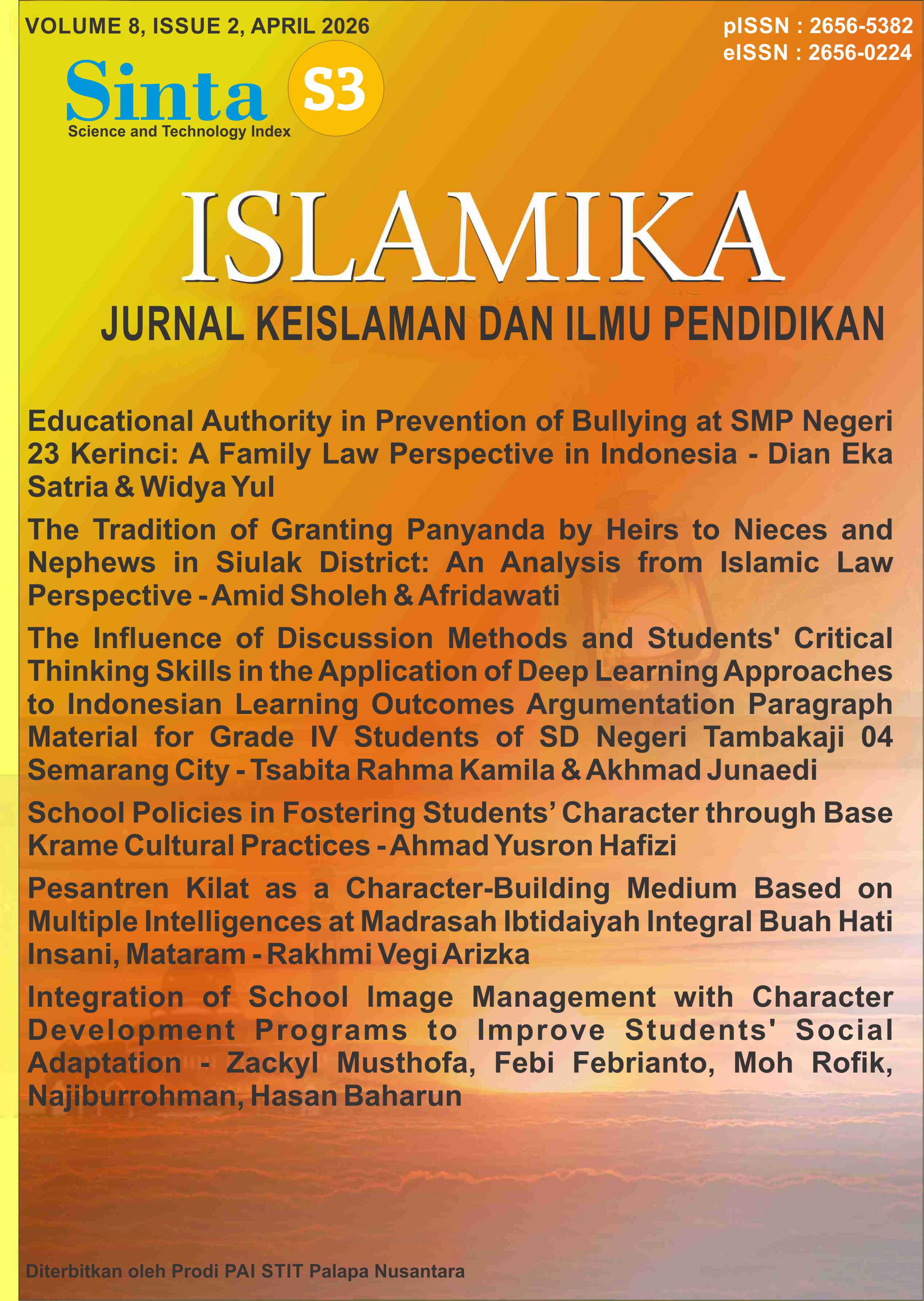
The Influence of Discussion Methods and Students' Critical Thinking Skills in the Application of Deep Learning Approaches to Indonesian Learning Outcomes Argumentation Paragraph Material for Grade IV Students of SD Negeri Tambakaji 04 Semarang City

Article Sidebar
 Digital Object Identifier:
10.36088/islamika.v8i2.6059
Digital Object Identifier:
10.36088/islamika.v8i2.6059
 Viewed : 106 times
 Downloaded : 74 times
















Main Article Content
1 Semarang State University, Indonesia, 2 Semarang State University, Indonesia
Abstract
Low learning outcomes in Indonesian language subjects, particularly in argumentative paragraph writing, remain a persistent challenge in elementary education, as many students struggle to construct logical arguments and express ideas critically, often due to teacher-centered instruction and limited discussion-based learning opportunities. This study examines the influence of discussion methods and students’ critical thinking abilities within a deep learning approach on Indonesian language learning outcomes. Using a quantitative approach with a quasi-experimental one-group pretest-posttest design, the study involved 24 fourth-grade students at SD Negeri Tambakaji 04, Semarang City, selected through saturated sampling. Data were collected through Indonesian language learning outcome tests and critical thinking questionnaires and analyzed using paired-sample t-tests, simple linear regression, and multiple linear regression in SPSS version 23. The results showed a significant improvement in students’ learning outcomes following the implementation of discussion-based deep learning, with the mean score increasing from 51.25 on the pretest to 86.88 on the posttest (t = −15.370, p < 0.05). Regression analysis further indicated that the discussion method had a positive and significant effect on learning outcomes (β = 0.737, p < 0.05), while students’ critical thinking ability also exerted a positive and significant effect (β = 0.807, p < 0.05). Collectively, these variables explained 85.6% of the variance in learning outcomes (R² = 0.856). The study concludes that integrating discussion methods and critical thinking development within a deep learning framework can effectively enhance Indonesian language learning outcomes, particularly in argumentative writing, and contributes empirical support for the design of more interactive and cognitively engaging learning environments in elementary Indonesian language instruction.
Citation Metrics:


Downloads
Article Details

Authors retain copyright and grant the journal right of first publication with the work simultaneously licensed under a Creative Commons Attribution-NonCommercial-ShareAlike 4.0 International License that allows others to share the work with an acknowledgement of the work's authorship and initial publication in this journal.
Find the perfect home for your research! If this journal isn't the right fit, don't worry—we offer a wide range of journals covering diverse fields of study. Explore our other journals to discover the ideal platform for your work and maximize its impact. Browse now and take the next step in publishing your research:
| HOME | Yasin | AlSys | Anwarul | Masaliq | Arzusin | Tsaqofah | Ahkam | AlDyas | Mikailalsys | Edumalsys | Alsystech | AJSTEA | AJECEE | AJISD | IJHESS | IJEMT | IJECS | MJMS | MJAEI | AMJSAI | AJBMBR | AJSTM | AJCMPR | AJMSPHR | KIJST | KIJEIT | KIJAHRS |